
Very interesting article, and Microvision is noticed.
Thanks Mike & Karen & John
LASER TO HOLOGRAPHIC COMBINER:
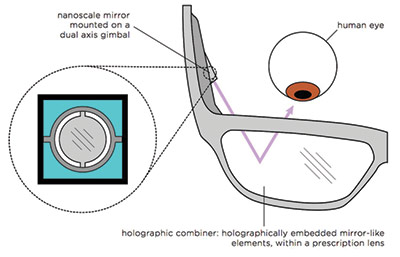
Pico-laser-based near-eye displays were pioneered by Microvision. With this kind of display system, a laser is bounced off a micro-mirror, mounted on a dual-axis gimbal. Early versions of these Microvision displays simply used a beam-splitter, otherwise known as a two-way mirror to combine the view of the real world with the view of virtual content. Over time, a more sophisticated optical combiner was developed, similar to the holographic waveguide. A series of micro-mirror-like holographic elements could be embedded inside a lens and the laser targeted at them, to reflect into the user’s eye. These laser displays—in their current form—have one distinct shortcoming compared to waveguides: a very narrow field of view (that being the width of the user’s view that can be augmented with virtual content). But as a competitor to waveguides, they also have a tremendous lens-crafters like Interglass of Switzerland, or Canadian consumer smartglasses brand, North, have shown that these kind of laser-based displays can be embedded within a traditional prescription lens.
LASER TO HOLOGRAPHIC COMBINER:
Pico-laser-based near-eye displays were pioneered by Microvision. With this kind of display system, a laser is bounced off a micro-mirror, mounted on a dual-axis gimbal. Early versions of these Microvision displays simply used a beam-splitter, otherwise known as a two-way mirror to combine the view of the real world with the view of virtual content. Over time, a more sophisticated optical combiner was developed, similar to the holographic waveguide. A series of micro-mirror-like holographic elements could be embedded inside a lens and the laser targeted at them, to reflect into the user’s eye. These laser displays—in their current form—have one distinct shortcoming compared to waveguides: a very narrow field of view (that being the width of the user’s view that can be augmented with virtual content). But as a competitor to waveguides, they also have a tremendous lens-crafters like Interglass of Switzerland, or Canadian consumer smartglasses brand, North, have shown that these kind of laser-based displays can be embedded within a traditional prescription lens.
North also has a patent to embed a waveguide within a prescription lens. Interglass says they’re also working on a waveguide within a prescription lens, and DigiLens have IP around a curved waveguide applied to the surface of a prescription lens. A representative from Interglass has suggested that a holographic waveguide embedded within a prescription lens should be expected in time for the Consumer Electronics Show in January 2020.
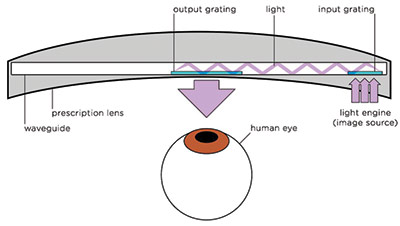
The waveguide display also requires a “light engine,” or micro-display to project into its input grating—the image source. These are also miniaturizing, getting brighter and falling in power consumption.
In future generations, expect lenses to combine displays with tunable focus lenses.
