Sudden traffic spikes make me wonder why.....
Largest Manufacturing Base for Samsung?
"Vietnam, a nation of 93 million, is the largest smartphone production base for Samsung Electronics. "
One in 10 Smartphones made in Vietnam
Wave of New Nokia Handsets?
BKAV

Showing posts with label Intel. Show all posts
Showing posts with label Intel. Show all posts
Monday, June 25, 2018

Saturday, February 10, 2018
List 'o links
Microsoft Holographic Display Patents
Microsoft Near Eye Displays for Augmented Reality.
Microsoft Near Eye Displays
AR Future with Glasses prototype (Microsoft)
Intel Consumer smart Glasses
Retinal Scan Display
Google Like Device you might actually wear
How Intel may succeed where google glass failed
Will lasers save intel's glasses from sucking?
Microsoft Near Eye Displays for Augmented Reality.
Microsoft Near Eye Displays
AR Future with Glasses prototype (Microsoft)
Intel Consumer smart Glasses
Retinal Scan Display
Google Like Device you might actually wear
How Intel may succeed where google glass failed
Will lasers save intel's glasses from sucking?
Wednesday, January 17, 2018
CES -- Partial Debrief.
I had a lot going on the last few days and wasn't able to give a CES debrief the time it deserved (so there was none).
This is the Hololens I had the opportunity to try. The company was using it and Oculus to look in brains.
Cool stuff, but the display needs work.


Just a taste of how busy the show is. This is ONE hallway in the Main area of the Las Vegas Convention center, and there were nine major display areas -- and hallways like this to connect them.


The Vuzix Blade.... more like a HUD that you wear than Augmented Reality. Cool Alexa integration, looks like they'll have some handy software. Something to watch as an eyewear solution, but not as a display competitor.

Hololamp has a cool tool, and we know that Microvision is in their toolbox. They said an issue with brightness.
I think that Engine Two brings them out strongly. Their projector now is quite large and intrusive, and it doesn't need to be. (their touch interactivity left something to be desired as well. But This as a tool could be very useful and fun.
Check out their Hololamp youTube Channel

Below is the ASU smart-cast watch. I think there's going to be very limited use of this -- at least in this view, it doesn't add much to the watch experience for its size. (use it to share pictures, or for teachers-- maybe.)
They admitted a strange relationship of this engine -- which is not MVIS, but is related to the Bosch Engine. The Bosch engine was featured in the lamp kind of product below -- the two mirror solution. It has lousy resolution. (showed a picture of someone at the front door, for example, who was unrecognizable.... the resolution is 480.)
I suspect the Bosch Engine is also produced by STM (It looks very similar.) and STM basically panned that engine at their presentation in Seattle.
[This was corrected by someone at Bosch: Thank you for your visit at Bosch booth during CES. I want to correct one comment on this side. You saw the ASU watch at our booth. The engine is produced not by STM then by Bosch. Could you please correct your comment on this side?
Thank you and best regards]
There are more moving parts to this space than it's possible to keep track of. (I'm not concerned about these iterations they're just showing that people are interested in the technology, and MicroVision's projector is clearly better -- brighter and higher resolution.


QD Laser the Retissa -- I only got a quick try with this. It does make an interesting floating image, and they tell me that the image is there and in focus no matter what the visual acuity of the wearer. (If you have to wear coke-bottle glasses, this still works perfectly.)
Unfortunately there was a very significant language barrier (OR they didn't want to answer my questions.)
I don't know if it's Microvision or not, but looks to be.
QDLASER Website


Someone's solid state car sensor. I'm going to stick my neck out and say the point cloud isn't that good.

Another display of sensors.

And a familiar looking Heads Up Display. (We're dealing with software. (I'm not seeing any tell-tale scan lines.) Of course it was impossible to see everything. It would have been impossible to see all of the auto area.

This is the Hololens I had the opportunity to try. The company was using it and Oculus to look in brains.
Cool stuff, but the display needs work.


Just a taste of how busy the show is. This is ONE hallway in the Main area of the Las Vegas Convention center, and there were nine major display areas -- and hallways like this to connect them.


Sometimes the booth numbers were difficult to find. (One of the more than 9 maps.... there were also suites, outdoor areas, and other spaces divided up for display and meetings.)

Which leads to walking days like this....

Other days, not so dramatic, because of a lot of time waiting in line. It took 40 minutes to get to the Vuzix Blade.

Hololamp has a cool tool, and we know that Microvision is in their toolbox. They said an issue with brightness.
I think that Engine Two brings them out strongly. Their projector now is quite large and intrusive, and it doesn't need to be. (their touch interactivity left something to be desired as well. But This as a tool could be very useful and fun.
Check out their Hololamp youTube Channel

Haier -- << the link there shows a projection Air Conditioner... I was probably ten feet away from it, but missed it.
Below is the ASU smart-cast watch. I think there's going to be very limited use of this -- at least in this view, it doesn't add much to the watch experience for its size. (use it to share pictures, or for teachers-- maybe.)
They admitted a strange relationship of this engine -- which is not MVIS, but is related to the Bosch Engine. The Bosch engine was featured in the lamp kind of product below -- the two mirror solution. It has lousy resolution. (showed a picture of someone at the front door, for example, who was unrecognizable.... the resolution is 480.)
I suspect the Bosch Engine is also produced by STM (It looks very similar.) and STM basically panned that engine at their presentation in Seattle.
[This was corrected by someone at Bosch: Thank you for your visit at Bosch booth during CES. I want to correct one comment on this side. You saw the ASU watch at our booth. The engine is produced not by STM then by Bosch. Could you please correct your comment on this side?
Thank you and best regards]
There are more moving parts to this space than it's possible to keep track of. (I'm not concerned about these iterations they're just showing that people are interested in the technology, and MicroVision's projector is clearly better -- brighter and higher resolution.


QD Laser the Retissa -- I only got a quick try with this. It does make an interesting floating image, and they tell me that the image is there and in focus no matter what the visual acuity of the wearer. (If you have to wear coke-bottle glasses, this still works perfectly.)
Unfortunately there was a very significant language barrier (OR they didn't want to answer my questions.)
I don't know if it's Microvision or not, but looks to be.
QDLASER Website


Found the Sanbot -- Notice that it will use "Alexa for home use" and that it has a projector in the back of its head. It's MicroVision's stuff. (Sony engine) The picture here doesn't do the picture on the wall justice.


This is as good a picture I could get of Goertek.


Another display of sensors.

And a familiar looking Heads Up Display. (We're dealing with software. (I'm not seeing any tell-tale scan lines.) Of course it was impossible to see everything. It would have been impossible to see all of the auto area.

Tried every kind of Augmented reality display I could get my hands on... Microvision doesn't have much to worry about there.... AR NEEDS MicroVision.
Sunday, June 4, 2017
The path to the singularity.
All this computing power is going to need.... 3D scanning, large displays in small packages, (The internet of things -- where tiny devices collect a lot of information,) and near-eye displays.
The display might not be as glamorous as the logic chip, but it's an essential component.
You more reliably make money during the gold rush if you're selling picks, shovels, food and clothing to the miners...
And with STM as a partner on the way, and cooperation with Intel, MVIS is in the right place at the right time.

The display might not be as glamorous as the logic chip, but it's an essential component.
You more reliably make money during the gold rush if you're selling picks, shovels, food and clothing to the miners...
And with STM as a partner on the way, and cooperation with Intel, MVIS is in the right place at the right time.

Thursday, May 25, 2017
Renault to Acquire Software R&D from Intel
There is a LOT of interest in this area, and a lot of moving parts.
What the exact results of this deal will be we don't know. It's possible that Renault wants to sell technology as much as automobiles.
In the realm of hardware for self driving cars, Microvision has a very nice place at the table. A great mid-range laser scanning technology.
Don't forget the recent highlighting of cooperation between Microvision and Intel. (This is no accident.)
AutomotiveIT
The R&D unit specializes in embedded software, which is important for the development of connected and autonomous cars. Renault said the acquisition, set to be finalized this year, will bring more than 400 software experts to the company.
***
The transaction doesn’t mean Intel, the world’s largest chipmaker, is losing interest in the car industry. The California-based company has recently stepped up its automotive activities, focusing on autonomous-driving technologies.
Earlier this month, Intel opened a Silicon Valley innovation center for autonomous driving. And in March, it signed a definitive agreement to acquire sensor specialist Mobileye. Sensors are an important source of data future cars will need to drive autonomously.
To address the major technological challenges of the future and pursue profitable growth, Renault has four primary focuses: international development; complementary coverage across its three brands (Renault, Dacia and Renault Samsung Motors); electric vehicles; and its alliance with Nissan.
"They'll be bringing Renault expertise, advanced methods and tools, plus access to a sound network of suppliers, laboratories and partner companies. Some teams already have automotive-specific skills in multimedia and connectivity."
The acquisition will proceed through Groupe Renault purchasing a company formed by Intel to take in the embedded software R&D activity at the Toulouse and Sophia Antipolis sites. The new company will be attached to the Groupe Renault Alliance Systems Engineering Department.
Wednesday, May 17, 2017
...the key component of the next big things...
During World War Two, Allied bombing missions were conducted -deep into German territory, to destroy factories in Schweinfurt. They were costly missions - but the were conducted for a very good reason.
"Low-friction ball and roller bearings were used in all parts of military and commercial machinery, and research indicated that roughly half of the German bearing industry was located in Schweinfurt, concentrated at four or five factory sites on the western side of town. The 8th Air Force planners felt that if they could strike hard enough at Schweinfurt, the results might cripple the German war industry." Third Reich Ruins
Striking at something that was a key component of everything they were fighting against made a lot of sense.
How does this translate to investing in modern technology?
If you can find something that would be a key component in a number of areas, that is where you'd want to be.
Microvision will be providing key components for the next big things. The ball bearings of impending tech trends:
Mobile computing: The smaller the device the better. The larger the display the better.
The internet of things is real, getting bigger and it's going to be gigantic. What is the easiest way to put an interactive display on something?
Augmented reality -- needs both near eye displays, and 3D scanning.
Autonomous vehicles - need displays and the means of detecting nearby objects and knowing what they are.
A lot of technologies need to work together to make this happen. (And a lot of cooperation)
Having the right partners... that's important too.
STM, Sony, Sharp/Foxconn and Intel
Gartner Top Ten Tech Trends 2017
Gartner Top Ten Tech Trends 2016
"Low-friction ball and roller bearings were used in all parts of military and commercial machinery, and research indicated that roughly half of the German bearing industry was located in Schweinfurt, concentrated at four or five factory sites on the western side of town. The 8th Air Force planners felt that if they could strike hard enough at Schweinfurt, the results might cripple the German war industry." Third Reich Ruins
Striking at something that was a key component of everything they were fighting against made a lot of sense.
How does this translate to investing in modern technology?
If you can find something that would be a key component in a number of areas, that is where you'd want to be.
Microvision will be providing key components for the next big things. The ball bearings of impending tech trends:
Mobile computing: The smaller the device the better. The larger the display the better.
The internet of things is real, getting bigger and it's going to be gigantic. What is the easiest way to put an interactive display on something?
Augmented reality -- needs both near eye displays, and 3D scanning.
Autonomous vehicles - need displays and the means of detecting nearby objects and knowing what they are.
A lot of technologies need to work together to make this happen. (And a lot of cooperation)
Having the right partners... that's important too.
STM, Sony, Sharp/Foxconn and Intel
Gartner Top Ten Tech Trends 2017
Gartner Top Ten Tech Trends 2016
Monday, April 24, 2017
Intel and Microvision
Well, this takes a lot off the threat board. (If you thought Intel was a threat to Microvision.)
And this puts a lot of fuel in the rocket!
And this puts a lot of fuel in the rocket!
Microvision is in the right place, at the right time, with the right technology working with the right partners.
By Mike Naldrett, MicroVision, Inc.
The Intel® Joule™ System on Module has features honed for the small form factor market that lend size, weight and power consumption benefits to projected display, interactivity with projected images, and 3D sensing.
Today’s musts for personal electronics pack a great deal of punch into otherwise small packages. Among these necessities is the desire for mobility and the availability of devices that are not only smart and sleek, but portable. On-the-go lifestyles are requiring technology component manufacturers to focus more and more on small form factor product design.
*****
Enabling Innovation
In the development of the PSE-0403 small form factor display engine and PSE-0403sti short throw interactive display engine, MicroVision recognized that combining these engines with other specialized small form factor solutions, such as the Intel™ Joule™ compute module, can enable new, compelling products that can be rapidly brought to market.
The Intel Joule Compute Module is helping bring MicroVision’s new short throw interactive display engine to life. As a complementary solution to MicroVision’s PicoP® scanning engine, the Intel Joule module generates the processing power needed to run interactivity algorithms for next-generation, “beyond the screen” devices.
In going beyond the screen, developers can implement touchless gesture capabilities in consumer-facing applications like speakers, light fixtures, security alarms, or even robot assistants and other artificial intelligence devices. These combined gesture recognition and projected display technologies enable products that boast a natural user interface—eliminating the need for an LCD screen while offering extreme portability.
*****
The same types of features can also be deployed in commercial settings. Virtual touchscreens in restaurants (Figure 3) could streamline the dining process and add entertainment value to the dining out experience, ranging from on-table menu selection and bill pay to on-demand games and other activities.
The same processing power that the Intel Joule Compute Module can provide for interactivity algorithms could also be used to enable other features, such as voice recognition and artificial intelligence. With the ability to introduce other sensor data as well, the platform opens up a wide variety of potential applications. Smart thermostats, home automation, and security centers are just a few among many possibilities. As these features are critical in the development of smart home solutions and accessories, it’s easy to see how the combination of this powerful system on module from Intel and MicroVision’s compact projection display modules can enable new and exciting applications across the growing smart home market, which is expected to reach more than $30 billion and a household penetration rate of over 60 percent by 2021.
With programs like its Developers Zone and tools like the Joule module, Intel is successfully linking inventors with suppliers of key-enabling technologies that foster new, forward-looking innovations. MicroVision is excited to be part of an ecosystem of new technologies for future-ready products in the world of mobility and IoT.
Intel Joule Compute Module
Monday, May 30, 2016
Intel Acquires Itseez Facebook acquires TwoBigEars
There is a lot of tech money out there chasing opportunities.
As stockholders in MicroVision, that's great for us -- unless we accept too little for our shares.
PC-Tablet
As stockholders in MicroVision, that's great for us -- unless we accept too little for our shares.
PC-Tablet
Itseez based in San Francisco was founded in 2005 to make computer vision algorithms and software. Along with that, it also includes a suite of algorithms for automobiles called “advanced driver assistance systems.” This unique feature allows car hardware to recognize pedestrians and traffic signs and can help in detecting when a car drifts from its lane.
Apart from the automotive field, Itseez has also developed algorithms for robotics, surveillance, smartphones and sports analytics. Last month, Intel also announced the purchase of Yogitech, another IoT company. Other than this in 2015, it also brought Lantiq, which is known for making chips for smartphones.
Around 40% of Intel total revenue is generated through the data center and IoT Business. IoT has already helped Intel to survive in the time when PC market is seeing a decline in its popularity among the consumers and has contributed about $2.2 billion in revenue growth last year.
Now Itseez is incubating its next products: itSeez3D – a breakthrough consumer 3D scanning solution, a suite of ADAS algorithms and an embedded face solution Facense.
Itseez Products
Facebook Acquires TwoBigEars
Facebook has acquired a spatial audio technology company named Two Big Ears for an undisclosed amount. In a statement, the company said, “Our mission is to make VR audio succeed across all devices and platforms and continue to help creators make the best experiences for billions of people across the world.” Two Big Ears stated that support for its paid licenses will be wound down in the next 12 months.
Facebook Acquires TwoBigEars
Facebook has acquired a spatial audio technology company named Two Big Ears for an undisclosed amount. In a statement, the company said, “Our mission is to make VR audio succeed across all devices and platforms and continue to help creators make the best experiences for billions of people across the world.” Two Big Ears stated that support for its paid licenses will be wound down in the next 12 months.
Wednesday, February 17, 2016
Augmented Reality Sandbox
Scraped this one due to the source:
This is interesting. I saw this concept at CES in with Intel. When I showed the PicoPro, they loved the idea, and wanted it for their application -- saying it was exactly what they needed to use this.
Outside of teaching geography, there are good possible gaming and other applications for this concept.
Please go visit the source: Indiana University Southeast -- AR Sandbox

This is interesting. I saw this concept at CES in with Intel. When I showed the PicoPro, they loved the idea, and wanted it for their application -- saying it was exactly what they needed to use this.
Outside of teaching geography, there are good possible gaming and other applications for this concept.
Please go visit the source: Indiana University Southeast -- AR Sandbox
Maker Club plans to build augmented reality sandbox
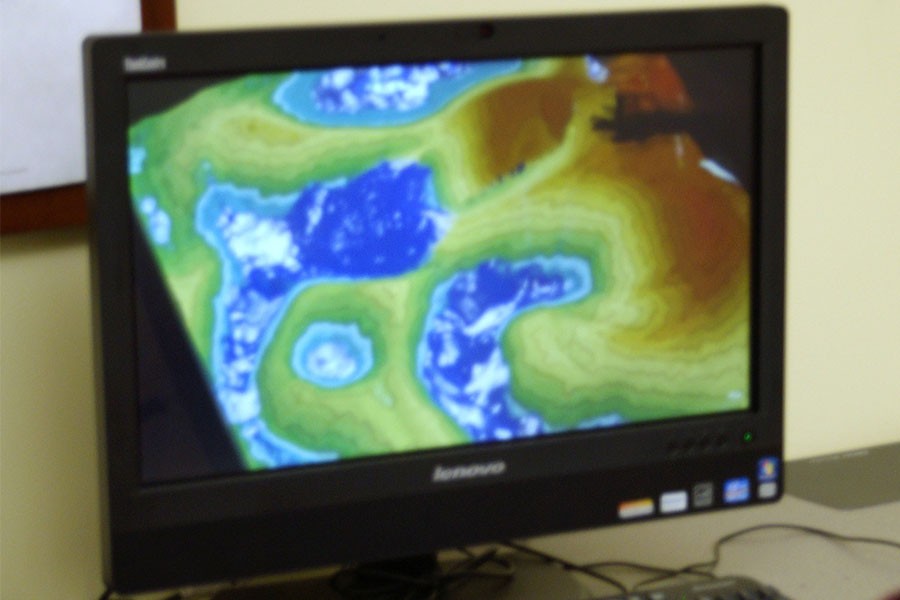
An augmented reality sandbox is shown at the Maker Club monthly meeting. 3-D topographical maps can be made in the sandbox by using a Kinect sensor and a projector.
The Maker Club may soon bring a sandbox that would act as a topographical mapping tool to IU Southeast.
The Maker Club met Saturday, Feb. 13 at 2 p.m. for its monthly meeting in the IUS Library, room 216, to discuss current and future projects. The members discussed various topics during the meeting, included setting up a date to build an augmented reality sandbox and repainting the arcade cabinet in the Life Sciences building, room 111-A.
Creating an augmented reality sandbox
The augmented reality sandbox concept was developed at the University of California, Davis, according to the university’s augmented reality sandbox webpage.
One major use of the sandbox is that it could be used to create 3-D topographical maps out of sand by using a projector and a Kinect sensor, Lukas DiBeneditto, informatics senior, said.
“By digging your hand in the sand you can change how the projection changes what the depth that is shown on it,” DiBeneditto said. “Essentially it was designed at universities to learn about geological processes.”
DiBeneditto said getting the software to work is the Maker Club’s goal before adding on to it later.
“We would like to get the geology department involved eventually,” DiBeneditto said.
DiBeneditto said the club will meet Saturday, Feb. 20 from 2 to 4 p.m. in the IUS Library, room 216 to work on the sandbox.
Repainting the arcade cabinet
The Maker Club members hope to repaint the arcade cabinet in the Life Sciences building, room 111-A, Matthew Wayne, computer science junior, said.
Wayne said the arcade cabinet was a collaboration between the Association for Computing Machinery, the Computer Security Group and the Maker Club.
“Basically it can run pretty much any game on it,” Wayne said. “It is a fully working arcade cabinet.”
Wayne also said the Maker Club members plan to paint the sides and, if given the opportunity, paint the front as well.
Changing and embracing technology
Originally called Hackerspace, the Maker Club focuses on robotics, electronics and 3-D printing, DiBeneditto said.
Joe Dukes, computer science major, said the name was changed because of the negative connotation of the word hacker.
“Hacking is really just disassembling things and reassembling them in different ways,” Dukes said.
DiBeneditto said the Maker Club is a hands-on club that focuses on the physical aspects of computer and information technology.
“It basically gives experience to the students at IUS to focus on the interests that they have,” DiBeneditto said.
Also, DiBeneditto said that although there were already computer science-focused clubs on campus, he wanted something similar for the informatics department.
“Informatics is a new field and it is being defined as we go,” DiBeneditto said.
DiBeneditto said informatics is an interdisciplinary science that takes a lot of different fields and puts them together by acting as the intermediary between technology, computer science professionals, and the user and seamlessly blends it together.
“I like that aspect,” DiBeneditto said. “Plus it’s fun, you get to build stuff.”
The Maker Club meets the second Saturday of every month at 2 p.m. in the IUS Library, room 216. However, the club members plan to increase the meeting times in order to meet the needs of the club’s projects. Students can join Maker Club by contacting DiBeneditto at lwdibene@ius.edu or by attending a meeting.
Indiana University Southeast -- AR Sandbox
Also, DiBeneditto said that although there were already computer science-focused clubs on campus, he wanted something similar for the informatics department.
“Informatics is a new field and it is being defined as we go,” DiBeneditto said.
DiBeneditto said informatics is an interdisciplinary science that takes a lot of different fields and puts them together by acting as the intermediary between technology, computer science professionals, and the user and seamlessly blends it together.
“I like that aspect,” DiBeneditto said. “Plus it’s fun, you get to build stuff.”
The Maker Club meets the second Saturday of every month at 2 p.m. in the IUS Library, room 216. However, the club members plan to increase the meeting times in order to meet the needs of the club’s projects. Students can join Maker Club by contacting DiBeneditto at lwdibene@ius.edu or by attending a meeting.
Indiana University Southeast -- AR Sandbox
Wednesday, January 6, 2016
Daqri -- pops up in a big way after a long silence
I do not know if we are in this product.
(it could be... I'll see if I can figure it out today.)
It is interesting that after a very long time of no word at all, there are dozens of articles about this thing this morning.
Daqri press release
DAQRI, the Augmented Reality company that is transforming the future of work, unveiled the next-generation DAQRI SMART HELMET™ today, powered by the 6th Gen Intel® Core™ m7 processor and Intel® RealSense™ technology. DAQRI SMART HELMET is an industrial-grade, human-machine interface that inserts real-time information – including Augmented and Mixed Reality work instructions, safety information, mapping and more – to maximize safety, productivity and well-being for workers in a variety of industrial settings. DAQRI founder and CEO Brian Mullins gave attendees a first look at the newest DAQRI SMART HELMET and its capabilities with an on-stage demonstration during Intel CEO Brian Krzanich’s CES keynote. DAQRI SMART HELMET has been in the pilot phase with Fortune 100 partners across industries including aerospace, construction, oil & gas and more, and will be available for purchase beginning in Q1 2016.
Silicon Republic
Engadget
(it could be... I'll see if I can figure it out today.)
It is interesting that after a very long time of no word at all, there are dozens of articles about this thing this morning.
Daqri press release
DAQRI, the Augmented Reality company that is transforming the future of work, unveiled the next-generation DAQRI SMART HELMET™ today, powered by the 6th Gen Intel® Core™ m7 processor and Intel® RealSense™ technology. DAQRI SMART HELMET is an industrial-grade, human-machine interface that inserts real-time information – including Augmented and Mixed Reality work instructions, safety information, mapping and more – to maximize safety, productivity and well-being for workers in a variety of industrial settings. DAQRI founder and CEO Brian Mullins gave attendees a first look at the newest DAQRI SMART HELMET and its capabilities with an on-stage demonstration during Intel CEO Brian Krzanich’s CES keynote. DAQRI SMART HELMET has been in the pilot phase with Fortune 100 partners across industries including aerospace, construction, oil & gas and more, and will be available for purchase beginning in Q1 2016.
Silicon Republic
Engadget
Saturday, January 10, 2015
Intel: This plus Picopro = portable PC
The Intel Compute Stick

This is the Intel Compute Stick, a humble HDMI dongle that houses a full desktop computer experience. It's not a particularly powerful one—you get a quad-core 1.33GHz Intel Atom processor, 2GB of RAM, and 32GB of solid state storage—but it does have Wi-Fi, Bluetooth, and both a full-size USB port and a microSD card slot for expandability. As long as you're not gaming and find yourself a decent couch controller, you could probably do quite a bit from this tiny PC! Here's the spec sheet.
More likely, it'll find a home in small businesses, schools, and the like who want to roll out super cheap computers to their employees, since all you need is this stick, an HDMI monitor and a couple peripherals to get things cranking. Remember when the tiniest PC was a nettop that hooked onto the back of your monitor? Now they come in dongle-form.
Tuesday, December 2, 2014
Google Glass Alive and Well
Peter Jungmann
There's a lot here to find interesting. A few snippets from the article have been pulled. If you are a long-term Microvision follower, you know that the company had a relationship with Motorola and has continued that relationship since it was purchased by Google.
Also, Google glass was mentioned during the stockholder meeting as "a fail in its current form." A significant part of that fail is the location of the display, it's limited field of view, and the fact that a user would have to refocus to look at the display. (I haven't used it so I can't speak from experience on that part of the matter.)
This article makes it clear that Google Glass isn't dead, but is still being quietly improved behind the scenes. Microvision will be an excellent choice to replace the display with a fuller field of vision.
I suspect the "commercial applications" they are talking about will come from the kind of applications featured in the video. With such applications possible I'm pretty sure the program will thrive.
From Patently Apple
Last week the U.S. Patent Office published a new Google Glass patent that was filed by their Motorola team that remains on board with Google.
So in the end, Google Glass is alive and well. It's just gone underground in an attempt to reinvent itself with new technology and a focus on high-end commercial applications.
There's a lot here to find interesting. A few snippets from the article have been pulled. If you are a long-term Microvision follower, you know that the company had a relationship with Motorola and has continued that relationship since it was purchased by Google.
Also, Google glass was mentioned during the stockholder meeting as "a fail in its current form." A significant part of that fail is the location of the display, it's limited field of view, and the fact that a user would have to refocus to look at the display. (I haven't used it so I can't speak from experience on that part of the matter.)
This article makes it clear that Google Glass isn't dead, but is still being quietly improved behind the scenes. Microvision will be an excellent choice to replace the display with a fuller field of vision.
I suspect the "commercial applications" they are talking about will come from the kind of applications featured in the video. With such applications possible I'm pretty sure the program will thrive.
From Patently Apple
Last week the U.S. Patent Office published a new Google Glass patent that was filed by their Motorola team that remains on board with Google.
If the user is authenticated then likely user location information is optionally utilized to further authenticate the user of the wearable device. For example, the authentication module implemented in the wearable device can optionally enhance the authentication of the user for some higher security applications by incorporating other information about the user, such as a location of the user, a route taken by the user, calendar information, and the like. If the current location of the wearable device (and user) is recognized as a likely location of the user, is a location along a likely route of the user, or is a location identified in a calendar appointment, then authentication may be further confirmed.
The last scenario definitely shows Google's is thinking of security issues in a work environment.
So in the end, Google Glass is alive and well. It's just gone underground in an attempt to reinvent itself with new technology and a focus on high-end commercial applications.
Thursday, March 27, 2014
INTEL Glasses... PicoP shaped projector?
[ the precise reason I scrape happened to this article. It is apparently no longer available at its original location, and I apparently have also lost the picture. ] The picture was pretty cool. I'll see if I can find it again.


Full Article
In The Future of Wearable Tech, iQ by Intel and PSFK Labs explore the evolving form and function of our Internet-connected devices. This series, based on a recent report, looks at the rise of wearable technologies and their impact on consumer lifestyles.
As we move into an era where we are increasingly dependent on our devices, even being without your phone for a few hours can feel rather disorientating. Now imagine that same scenario ten years from now when these same technologies are even further embedded into the fabric in our lives.
Science fiction novels and works of pop culture play out these promising and often scary scenarios, but in reality humans are rapidly leveraging the advances in computational size, processing speed, and sensor technology to augment our natural abilities.
Far from dystopian, the future of this hybrid human and machine mix offers the incredible possibility to replace or correct for limitations caused by degenerative conditions or other physical and mental shortfalls. A trend that could be called “Augmented Sensory Perception” is rising from early experiments that closely align and even integrate technologies with the human body to enhance existing perceptions and faculties. Whether through biomedical research or DIY ‘hacks’, these innovations are designed to overcome personal challenges, while pushing the boundary in terms of what is possible.
Subscribe to:
Posts (Atom)