Showing posts with label retinal scan. Show all posts

Friday, October 9, 2015

Fujitsu Retissa - Laser

I give this 95% chance we're in here. Retinal scanning is MicroVision. Retinal scanning with lasers and mirrors? I'm pretty sure it's us.

I will of course be digging for more.

Perhaps we'll start trading like a hot new biotech. Curing a significant amount of the blindness in the world should be worth a bit.


From UberGizmo

At Fujitsu

Toronto Sun - Images from CEATEC (Note how nicely RoBoHon shows as well.)
See slide #8 for Retisssa

"Basically, RETISSA works this way – it will project an image directly into your retina using the wonders of mirrors – where a RGB laser beam will be sent to a MEMS mirror, which in turn is relayed over to the reflecting mirror installed in the RETISSA itself, where your retina will then pick up that image."

"there are plans to roll it out next March with the help of medical universities, ophthalmology hospitals, educational institutions and optician stores."

Tuesday, May 12, 2015

Fujitsu Laser Glasses

I must admit that I haven't found a direct connection between MicroVision and this Fujitsu project. However, retinal scan display, and "shooting lasers into the eye" displays are MicroVision's realm, so this is worth close attention.


At PC World

At CIO

At ITProPortal
The basic idea of projecting imagery onto a retina via laser has been around for decades, but miniaturizing the optics to realize a wearable form factor had been difficult until recently. Fujitsu and partner companies were able to produce a small mirror to project light into the eye.

“By using these glasses, people with low vision will be able to read books, newspapers, bulletin boards, timetables and walk around outside,” said Mitsuru Sugawara, CEO of QD Laser, a Fujitsu spinoff based in Kawasaki that helped develop the glasses.

Sunday, May 3, 2015

Displays you Wear - Updated

From Photonics.com

Check out the full article at the original source.

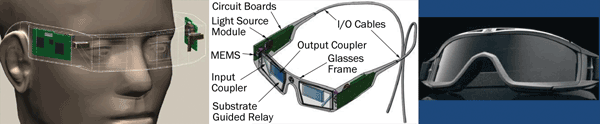
Note that the image of the glasses below does look quite similar to what is described for the Hololens system, and also quite similar to the glasses shown here: ValveAR


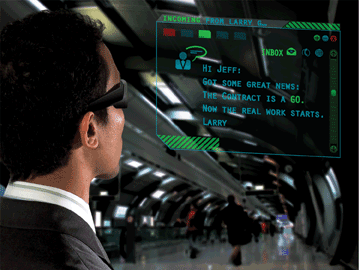
The laser scanning projection system enables augmented reality wearable glasses.

The laser scanning projection system enables augmented reality wearable glasses. Photo courtesy of MicroVision.


“Often overlooked is the whole human-machine interface. That’s the biggest problem,” said Bharath Rajagopalan, general manager for business development and marketing at projection display maker MicroVision Inc. of Redmond, Wash. The company’s laser beam scanning technology can be incorporated into augmented reality products, including head-up and retinal scanning displays. 

“We’ve been ready for a long time,” 
Rajagopalan said of the company’s decade-old augmented reality technology. “We have good, sharp text. It’s very crisp, very readable, very high contrast.” 

Originally developed for the military, MicroVision’s lightweight head-worn displays deliver images that appear to the user as though on a see-through computer screen – thus a technician can view instructions on jet engine repair while performing the task. 
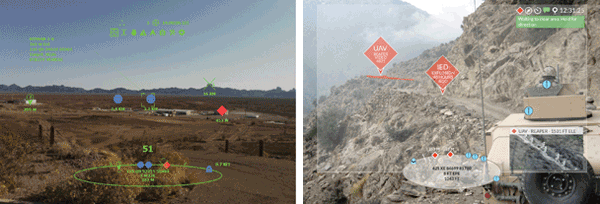
Originally developed for the military, augmented reality technology allows information to be displayed and shared outdoors.
Originally developed for the military, augmented reality technology allows information to be displayed and shared outdoors. Photo courtesy of Applied Research Associates.

What’s needed in addition to a quality display is infrastructure, according to Rajagopalan, which includes access to data, sufficient computing power and the right software. 


A laser scanning projection system by MicroVision.
A laser scanning projection system by MicroVision. Photo courtesy of MicroVision.