Showing posts with label Google Glass. Show all posts

Monday, August 12, 2019

The Return of Consumer Smart Glasses

Very interesting article, and Microvision is noticed.


Thanks Mike & Karen & John


LASER TO HOLOGRAPHIC COMBINER:

Pico-laser-based near-eye displays were pioneered by Microvision. With this kind of display system, a laser is bounced off a micro-mirror, mounted on a dual-axis gimbal. Early versions of these Microvision displays simply used a beam-splitter, otherwise known as a two-way mirror to combine the view of the real world with the view of virtual content. Over time, a more sophisticated optical combiner was developed, similar to the holographic waveguide. A series of micro-mirror-like holographic elements could be embedded inside a lens and the laser targeted at them, to reflect into the user’s eye. These laser displays—in their current form—have one distinct shortcoming compared to waveguides: a very narrow field of view (that being the width of the user’s view that can be augmented with virtual content). But as a competitor to waveguides, they also have a tremendous lens-crafters like Interglass of Switzerland, or Canadian consumer smartglasses brand, North, have shown that these kind of laser-based displays can be embedded within a traditional prescription lens. 
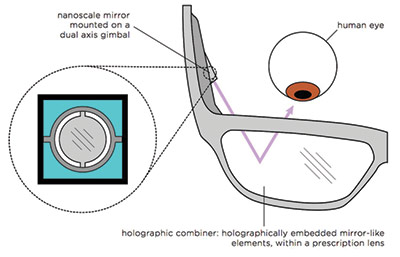
North also has a patent to embed a waveguide within a prescription lens. Interglass says they’re also working on a waveguide within a prescription lens, and DigiLens have IP around a curved waveguide applied to the surface of a prescription lens. A representative from Interglass has suggested that a holographic waveguide embedded within a prescription lens should be expected in time for the Consumer Electronics Show in January 2020.
The waveguide display also requires a “light engine,” or micro-display to project into its input grating—the image source. These are also miniaturizing, getting brighter and falling in power consumption. 
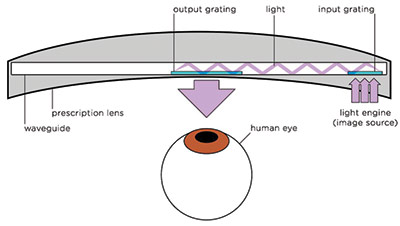
In future generations, expect lenses to combine displays with tunable focus lenses.

Wednesday, December 12, 2018

TESLA & AR Claiming some turf

I'm not a legal guy, but the text of the patent reads like it's some kind of legal shotgun, hoping to land on some use of AR that someone else hasn't already claimed.

Whether that's the case or not, it appears they're planning to use AR to improve their manufacturing processes.


In the text of the patent application (it's an application, not a grant) they use the "in some embodiments" phrase a lot, which is what makes me think they're just trying to claim some turf in AR -- just in case there are any specifics some of the other players missed.

It could mean they intend to come up with their own version (hardware / software) of AR devices, and this could be an interesting addition to the space. 


MVIS will still have the best near-eye display.

Google has already been using wearable tech.
The image shows multiple black Tesla Model S vehicles in view with a screenshot from APX’s “Skylight” software in the top-right hand corner. This is a familiar view for those who have used Glass before — the device is actually capable of capturing similar shots itself called Vignettes. In the screenshot, the software shows what is purportedly a vehicle’s VIN number, and various options for a factory worker to act on.

Electrek

ZDNet

In some embodiments, the AR glasses may be in the form of safety glasses. The AR device captures a live view of an object of interest, for example, a view of one or more automotive parts. The AR device determines the location of the device as well as the location and type of the object of interest. For example, the AR device identifies that the object of interest is a right hand front shock tower of a vehicle. The AR device then overlays data corresponding to features of the object of interest, such as mechanical joints, interfaces with other parts, thickness of e-coating, etc. on top of the view of the object of interest. Examples of the joint features include spot welds, self-pierced rivets, laser welds, structural adhesive, and sealers, among others. As the user moves around the object, the view of the object from the perspective of the AR device and the overlaid data of the detected features adjust accordingly. The user can also interact with the AR device. For example, a user can display information on each of the identified features. In some embodiments, for example, the AR device displays the tolerances associated with each detected feature, such as the location of a spot weld or hole. As another example, the overlaid data on the view of the object includes details for assembly, such as the order to perform laser welds, the type of weld to perform, the tolerance associated with each feature, whether a feature is assembled correctly, etc. In various embodiments, the AR device detects features of a physical object and displays digital information interactively to the user. The data associated with the object of interest is presented to help the user more efficiently perform a manufacturing task.”

Saturday, July 2, 2016

Insurance view of Technology

Property Casualty 360

This is  an article about insurance companies adopting new technology. It talks about the frustration of development timelines AND the value of delivering visual data.

Bring on PicoP.

Using Google Glass as a test case for all emerging technologies of the moment, consider it originally debuted to significant hype in early 2012 and went live in 2013, becoming a big hit with the public before eventually losing steam as the novelty wore off.  Last year, Google pulled back on investment in the Glass Explorer Program, and since then, the competition has stepped up, introducing multiple types of smart glasses. While there are now many choices of these devices, consumer interest in smart glasses has remained at a standstill, and true business value has yet to be proven. Why?

Value of visual data


Evaluating the applicability of Google Glass for insurance means recognizing the value visual data, such as photographs and video, can bring to the claim documentation and underwriting process. However, Google Glass in particular, and smart glasses overall, are of sound concept and excellent design, but the technology is not quite mature, especially when considered for business use. For example: 
(Battery life, processing power, overheating, smartphone integration, heads up display and prohibitive cost.)  -- And all of those problems will be solved with PicoBit.

Saturday, September 19, 2015

MicroVision WAY ahead of the competition

So, check this out. A load of companies say they're going to try to do something that's on the cutting edge -- equip their employees with smart glasses.

Why companies are RUSHING to fit their employees with smart glasses.

"In a recent survey conducted by Herndon, Va.-based APX Labs—who collected responses from 201 U.S.-based companies in various industries—60 percent of participants who don't currently use smart glasses were open to adopting it in the near future while 51 percent said they have plans for using smart glasses in the upcoming year."

"The smart glasses data represented a faster projected growth rate than any other “smart” wearable tech device mentioned in the report, including growth rates related to smart watches, activity/fitness trackers, indoor location sensors/beacons and wearable mobile cameras."

"In terms of industries where smart glasses will become prevalent, APX Labs CEO/founder Brian Ballard said that he believes manufacturing, field service, maintenance and repair, material handling and logistics, and inspection/quality control will be key. “These are important jobs, with lots of people and where improving performance in terms of process speed, employee productivity, production quality and compliance/safety has giant impacts on the bottom line,” he added."

Now, you may be thinking "What does this have to do with MicroVision?" Check this out. Not only is MicroVision a leader in IP in this space, but they've ALREADY DONE IT.


Their display is improved, and the software is improved, and they've already been 
there. Listen to these guys laugh at what's 10 years ahead of its time. Listen to the guy in the blue shirt.


The technology (the supporting software, tracking, and even the display, has caught up with sentiment.)


  Now that MicroVision has PicoP well in hand and ready to generate cash for the company through its partners (SONY & others), they can begin re-engaging with this market that is clearly now ready for what they have to offer.

WiseGeek What is a Virtual Retinal Display?


Friday, July 3, 2015

New Version of Glass on deck?

Something else to watch.

New Glass to focus on Enterprise


Engadget

"Before a company announces a device, it has to pass through the FCC's secretive bunkerto ensure that it's wireless radios are safe for human contact. Droid Life has trawled through the most recent list of anonymized gadgets to find A4R-GG1, a Google-hewn offering that might, just possibly, be the new version of Google Glass. The clues aren't exactly concrete, but include the fact that the hardware isn't classified as a smartphone, tablet or media device. It's equipped with 802.11 a/b/g/n/ac dual-band WiFi, Bluetooth LE and a built-in rechargeable battery, so clearly it's also meant to be taken around with you."